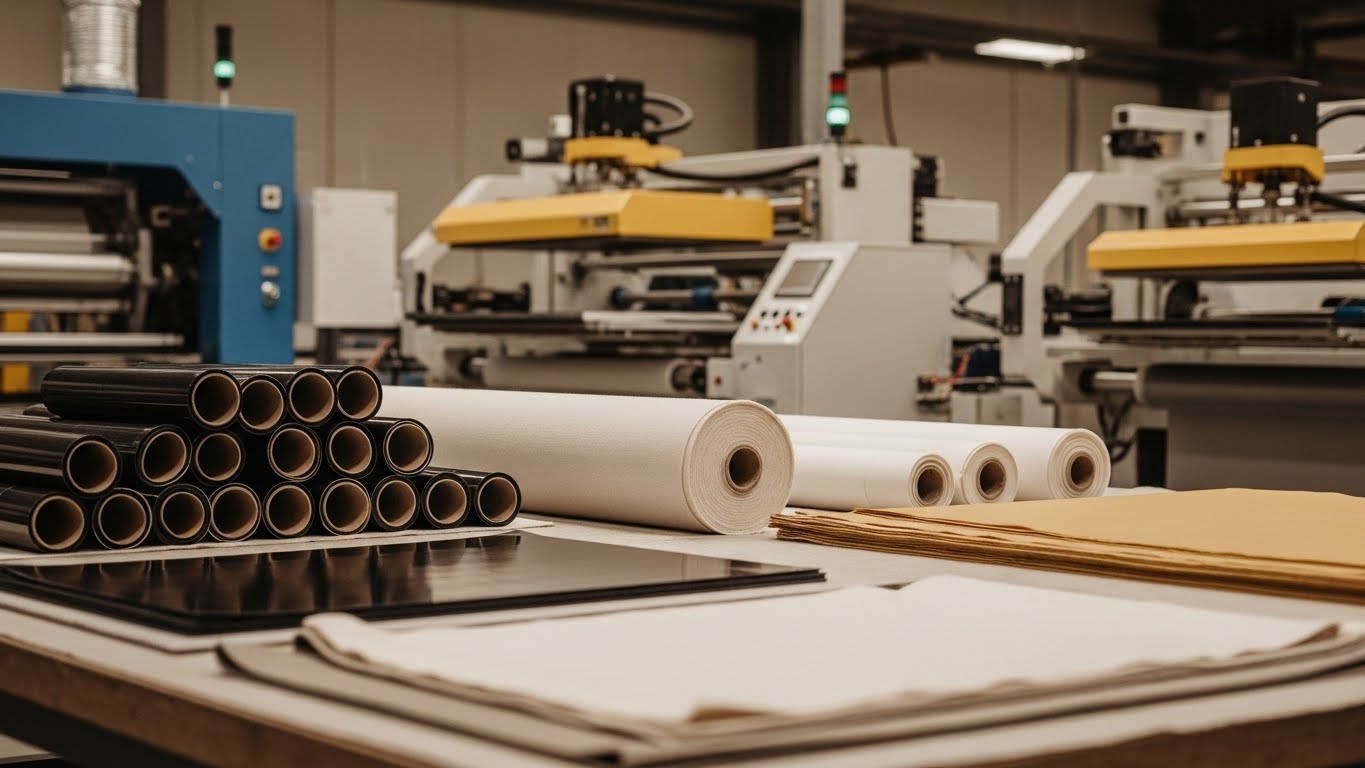
Two heat-activated materials are often confused on the production floor: interlining (in Turkish, “tela”) and hot melt adhesive film. Both carry an adhesive that melts under the press, but they are designed for different jobs. So when someone asks whether hot melt film can replace interlining, the answer depends on what the part needs: shape and body, or a stitch-free bond between two pieces? This guide explains which one to choose for attaching patches and labels, and when.
What does interlining do?
Interlining is an inner layer that gives a garment body and stability. It consists of a woven, knitted or nonwoven base fabric; on fusible grades, one side of that base is usually coated with thermoplastic adhesive dots (such as PA, PES or polyethylene). It keeps collars, cuffs, plackets, waistbands and flaps from collapsing and helps them hold their dimensions.
In embroidery, the same word is also used for stabilisers, the tear-away, cut-away or water-soluble backings that support the fabric while it is stitched. They carry the stitches; they are not designed to attach the patch to the garment.
What does hot melt film do?
Hot melt film is a continuous adhesive layer with no base fabric. It usually comes on a silicone release paper and, once heat-activated, bonds two surfaces together. That is why films such as hot melt BSN replace sewing thread: they are used to fix embroidered or woven patches, labels and epaulettes to fabric, and for seamless hemming and panel bonding. Thickness (in microns) and polymer type determine bond strength and hand feel.
Key differences when attaching patches and labels
- Purpose: Interlining reinforces and stiffens a part; hot melt film joins two parts. Interlining on its own does not bond a patch to a garment.
- Adhesive coverage: On dot-coated interlining the adhesive does not cover the whole surface. A film is a continuous layer that bonds along the entire edge of the patch, so it is usually more reliable against edge lifting.
- Hand feel: Interlining adds body by design. With film, stiffness depends mainly on thickness; a film that is thicker than needed leaves a plasticky feel.
- Breathability: A continuous film reduces airflow over large areas. On small patches and labels the difference is not noticeable, but for large panels a porous adhesive web or an interlining may be the better fit.
- Washing and dry cleaning: For both products, durability depends on the polymer type and the application recipe. Match your target wash temperature and any dry-cleaning requirement against the supplier’s technical data sheet (TDS).
Which one should you choose?
- If you need a part to keep its shape or the fabric to gain body, use interlining; hot melt film is not a substitute.
- If you want to attach a patch, label or epaulette without stitching, choose hot melt film.
- On embroidered patches the two can work together: the design is stitched on a stabiliser, hot melt film is applied to the back, and the patch is then pressed onto the garment.
- If an existing product has edge-lifting problems, check temperature, dwell time, pressure and cooling before changing the material; the cause is not always the adhesive.
- Confirm the choice with a sample test on your own fabric, at the planned wash temperature and number of cycles.
For film types and micron options, see the Hot melt BSN film page, and for planning the tests, read the wash durability guide.
Related solutions
This article was summarised and commented on by the LTS Frekans editorial team, drawing on the source article.